Facebook Ads Learning Phase: How to Exit Faster and Stop Resets in 2026
Half of all wasted Facebook Ads spend in 2026 happens inside the learning phase. Ad sets that never exit. Ad sets that exit on day four and get reset on day five because someone tweaked a headline. Ad sets killed on day two because a media buyer confused first-48-hours noise with a dead creative.
The learning phase is not a Meta marketing gimmick. It is the window in which the delivery system is building an internal model of who, when, and where your ad should show. That model is garbage until it has seen roughly 50 of your optimisation events. Everything you care about — CPA, ROAS, frequency, placement mix — stabilises only after the model does.
This guide covers the 50-event rule as it works in 2026, the edits that silently reset learning, a 72-hour exit playbook, and the mistakes that quietly drain budget before the ad set ever has a chance.
What the learning phase actually is
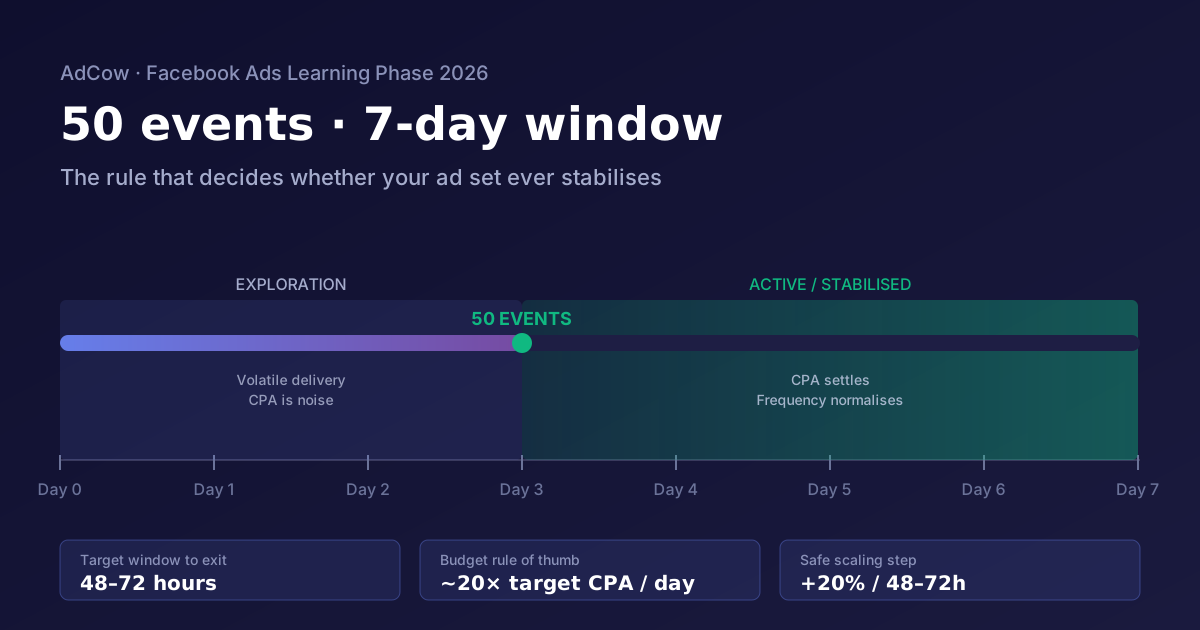
An ad set enters the learning phase the moment it is first published or after any significant edit. The phase ends when the ad set records 50 optimisation events inside a rolling 7-day window. A purchase-optimised ad set needs 50 purchases in 7 days. A lead-optimised ad set needs 50 leads. Higher-funnel events exit faster, deeper events take longer.
During learning, delivery is deliberately volatile. Meta is spending your money on exploration — showing the ad to a wider mix of audiences and placements than it will later — because it has no idea yet where your conversions live. CPA in the first 48 hours is not a read on how the ad set will perform. It is the cost of buying training data for the bidder.
Three outcomes are possible at the end of the phase:
- Active. You cleared 50 events inside 7 days. Delivery stabilises, CPA settles, exploration drops, exploitation takes over.
- Learning Limited. You did not clear 50 events in 7 days. Meta stops trying to find a stable audience and just spends your money on whatever the current best guess is. Performance usually gets worse, not better, from here.
- Reset. Something changed — budget, audience, creative, bid — and the counter goes back to zero. Your last 7 days of learning are thrown away.
The 50-event rule in 2026
The 50-events-in-7-days number has not changed in years and is not going to. What has changed is how easy it is to hit.
Post-iOS 14.5 attribution losses mean Meta counts fewer events than actually happen. Conversions API helps, and in 2026 most serious advertisers have it wired up, but even with CAPI you are looking at a 5–15% undercount on average. That tightens the maths: an ad set that needs a $1500 daily budget at a $30 CPA on paper probably needs $1800–$2000 to safely exit learning when you factor in undercount and exploration volatility.
Meta also recommends that a single ad set hit the 50-event threshold on its own. Rolling events up to the campaign level does not exit learning for ad sets underneath. If you run 6 ad sets at $100/day each under a $600 CBO, each one still has to find 50 events individually.
Edits that silently reset the learning phase
Most resets in 2026 are self-inflicted. A media buyer tweaks something small, the system marks it as a significant edit, the counter zeroes, and nobody notices until CPA blows up three days later.

These edits reset learning. Avoid them once an ad set has cleared the phase unless you have a genuine reason to go back to day zero:
- Changing the optimisation event. Switching from "Leads" to "Purchases" is always a full reset.
- Changing the bid strategy. Flipping between Lowest Cost, Cost Cap, Bid Cap and Minimum ROAS is always a reset.
- Bid cap or cost cap value changes. Even small numeric tweaks count as a significant edit.
- Budget changes above ~20% in a single day. Anything inside ±20% is usually safe. Going from $100 to $150 on the same day will typically trip a reset.
- Audience edits. Adding or removing a Custom Audience, changing the location, narrowing the age range, swapping interests — all reset.
- Placement edits. Adding Reels, removing Audience Network, switching from Advantage+ Placements to manual — all reset.
- Adding or removing ads inside the ad set. Adding a new creative version forces the ad set back into learning while the new ad finds its footing.
- Pausing longer than 7 days. A pause under 7 days resumes where you left off. A pause over 7 days restarts the phase when you switch delivery back on.
Safe edits that do not reset: headline and primary text tweaks on an existing creative (within limits), ad set name changes, schedule tweaks inside the same day, and dark post ID swaps for an identical creative.
How to exit the learning phase in 72 hours
The playbook below gets a normal ad set through the phase on day 3, not day 7. It only works if you can feed the bidder enough conversion volume for the full 50-event run.
1. Size the daily budget against the target CPA
Work backwards from the event cost. If target CPA is $30, the ad set needs roughly $1500 of spend to buy 50 events. Distribute that across 3 days, add 20% for exploration slippage, and you get a daily budget of $600. Under that, you are handing the ad set a week-long starvation diet.
This is the single most common reason ad sets get stuck in Learning Limited: the daily budget is sized to the sum the buyer is comfortable losing, not to what the bidder needs to exit learning at target CPA.
2. Pick the right optimisation event
Optimise for the event that actually happens often enough to hit 50 in 7 days. If Purchases give you 8 events a day, the ad set exits learning in 7 days exactly. If Purchases give you 3 events a day, you never exit and you should optimise one step up — Initiate Checkout, Add to Cart, or a Custom Conversion tuned to a reliable mid-funnel signal.
Down-funnel optimisation is always better when the volume is there. When the volume is not there, up-funnel optimisation is better than a permanent Learning Limited.
3. Consolidate ad sets, not budgets
Two $300/day ad sets with overlapping audiences cost you twice the learning phase and split the event signal in half. One $600/day ad set clears the phase on day 2 and keeps learning sharper.
Before launching, audit whether you really need the ad set to be separate, or whether it exists out of habit. Fewer ad sets, more budget each, is the shape of a healthy 2026 campaign.
4. Launch with 3 to 6 creatives, not 1
Single-creative ad sets lose to multi-creative ad sets in learning because the bidder has nothing to A/B. Three to six creatives in a single ad set give the system enough variety to find a working hook while still exiting the phase on schedule.
More than six creatives dilutes spend per ad below the threshold where any of them can stabilise. Stay in the 3–6 range unless you are running a dedicated creative test at much larger budget.
5. Do not edit for 72 hours
Launch the ad set and walk away for 72 hours. No budget tweaks. No creative swaps. No audience rebuilds. No bid changes. Every edit in the first 3 days is a gift back to the bidder.
You can still monitor hook rate, CTR, and cost per outbound click inside the first 24 hours to catch a catastrophic creative. But if the numbers are merely ugly — not catastrophic — let the bidder finish its job.

Learning Limited — what to do when you get stuck
Learning Limited is a diagnosis, not a death sentence. The failure mode is specific: the ad set spent 7 days chasing a target that was out of reach. Fix the root cause instead of duplicating.
Root causes and fixes, in the order you should check them:
| Symptom | Cause | Fix |
|---|---|---|
| Spend lands below $300–500/day on a purchase objective | Daily budget too small for target CPA | Consolidate two ad sets, or raise the budget to roughly 20× target CPA |
| Audience size under 1M | Audience too narrow to find 50 unique converters | Switch to Advantage+ audience, broaden the location, or expand the lookalike |
| Optimising for Purchase but getting 1–2 events/day | Event too rare for the current budget | Optimise one step up the funnel — AddToCart, InitiateCheckout, or a Custom Conversion |
| Lots of impressions but CPA 2–3× benchmark | Creative or offer mismatch, not a delivery problem | Kill the ad set, fix the creative, relaunch fresh — more budget does not rescue a dead creative |
| Frequency above 4 in week 1 | Audience too small or too much budget | Widen the audience or lower the budget; high frequency inside learning inflates CPA |
Duplicating a Learning Limited ad set is the reflex move and almost always the wrong one. The duplicate starts at zero events and hits the same ceiling. The fix is structural, not cosmetic.
The "edit budget" you get every week
On top of the structural rules, Meta leaves a quiet allowance for small tweaks. On an active ad set, you can make budget changes of up to about 20% in a single day without triggering a reset. Going above that on the same calendar day — even in multiple smaller steps that add up to more than 20% — usually resets.
Scaling discipline for 2026 looks like this: every 48–72 hours, raise the budget by no more than 20%, wait for delivery to stabilise, then raise again. A $500/day winner goes to $600 on day 3, $720 on day 5, $864 on day 7. That is 73% scale in a week with no resets. Aggressive scalers who try to jump from $500 to $1000 overnight pay for it in a fresh learning phase, and the CPA gains from the jump get eaten back.
Advantage+ campaigns and learning
Advantage+ Shopping Campaigns (ASC) have a different learning profile. The campaign exits on a lower event threshold — Meta has not published a number, but in practice ASC ad sets stabilise with 20–30 events instead of 50 — because the system pools signal across a broader audience.
ASC is also more tolerant of edits once live. Adding a new creative to an ASC campaign does not fully restart learning on existing creatives the way it does for a manual ad set. That flexibility is one of the reasons ASC is the default on ecommerce accounts in 2026.
The trade-off is less control over placement, audience, and budget routing. If you need to test a specific audience hypothesis, manual ad sets are still the right tool. If you need scale and you are willing to hand control to Meta, ASC is structurally better for exiting the learning phase.
Mistakes that quietly waste budget inside learning
- Killing ad sets on day 1 or day 2. First-48-hours CPA is noise. Read it on day 3, not day 1.
- Editing creatives during the phase. Every swap restarts learning. Batch creative changes into a new ad set.
- Multiple resets in 7 days. Two resets in a week mean the ad set never hits 50 events. Either stop editing or start over cleanly.
- Turning off the pixel diagnostics. Missing events make the phase harder. Check Event Match Quality monthly.
- Launching 15 ad sets of $50/day. Split budget, split events, none of them exit. One $750/day ad set is almost always better.
- Scaling by budget changes above 20% in a day. Scale in steps. Each reset is a full week of wasted spend.
- Optimising for Purchase when you get 1 purchase a day. You will never exit. Move up the funnel until volume is there.
- Using the duplicate button as a debug tool. A duplicate inherits nothing. You start from zero every time.
What to remember
- 50 optimisation events in a rolling 7-day window. That is the rule. Everything else is tactics.
- Daily budget should buy 50 events in 3 days, not 10. Starve the ad set and it never exits.
- Every significant edit is a gift back to the bidder. Treat edits like a resource with a weekly cap.
- Learning Limited is a structural failure. Fix the cause; do not duplicate the ad set.
- Scale in 20% steps every 48–72 hours. Slow beats aggressive on Facebook in 2026.
Running ad sets that keep getting stuck in learning?
AdCow agency ad accounts come with higher daily spend limits and fewer moderation pauses, so your ad sets actually get the 3 stable days they need to exit the phase. See AdCow agency accounts.