Facebook Ads Campaign Structure: The Setup That Stops You Wasting Money in 2026

Most advertisers lose money before a single person sees their ad. The campaign structure is wrong. A messy setup splits budget across too many ad sets, and the ones that could perform get starved of data.
This guide walks through Facebook Ads account organization from the top down: campaign hierarchy, ad set logic, naming conventions, budget allocation, and the structural mistakes that drain accounts month after month.
Why Campaign Structure Determines Your Results
Meta's delivery algorithm needs data. Who sees your ad, when, on what placement: every one of those decisions relies on conversion signals from your pixel or Conversions API. Scatter those signals across too many ad sets and each one gets a fraction of the data it needs. You get random delivery instead of optimization.
A well-structured account concentrates data so each ad set exits the learning phase faster. It separates variables so you can tell what works. And it scales without requiring you to rebuild from scratch.
Accounts spending $500/day with tight structure outperform accounts spending $5,000/day with scattered setups. Regularly.
The Three-Level Hierarchy
Facebook Ads has three levels. Every decision you make sits at one of them.
Campaign Level
You set the objective here, and the budget if using CBO. One campaign, one goal. Keep conversion campaigns separate from traffic campaigns. Keep prospecting separate from retargeting. The algorithm optimizes toward one objective per campaign. Mixed objectives give it contradictory instructions.
Ad Set Level
Each ad set defines who sees your ads and under what conditions: audience, placement, schedule, bid strategy, and (with ABO) budget. Each ad set tests one variable against the others. Ad Set A targets Lookalike 1%, Ad Set B targets Interest Stack: you are comparing audiences. Both target the same audience but different age ranges: you are comparing demographics.
Ad Level
The creative. Each ad within an ad set should differ by one element: the hook, the visual, or the format. Change the image and the headline and the format at the same time and you cannot pin performance on any single variable.

How Many Campaigns to Run
Depends on your daily spend and how many products or offers you run.
Under $100/day
One campaign, CBO, 2-3 ad sets. At this budget, multiple campaigns starve every one of them. Let Meta allocate spend to what works. Add new ad sets when you have clear winners and want to test a new audience angle.
$100-500/day
Two campaigns: one for prospecting (cold audiences), one for retargeting (warm audiences). The prospecting campaign gets 70-80% of budget. Retargeting gets the rest. Within prospecting, run 3-5 ad sets testing different audiences.
$500-2,000/day
Add a third campaign for scaling winners. The three-campaign structure becomes:
- Testing campaign (ABO) with new audiences and creatives, equal budgets
- Scaling campaign (CBO) for proven ad sets moved here with higher budgets
- Retargeting campaign (CBO) for website visitors, video viewers, engagement audiences
Over $2,000/day
Split by product line or funnel stage. You might have 5-8 campaigns, but each one follows the same internal logic: clear objective, focused ad sets, controlled variables.
Ad Set Organization: The Rules
The ad set level is where most advertisers make structural mistakes. These rules prevent the common ones.
One Variable Per Ad Set
Each ad set should differ from its siblings by one targeting variable. If you are testing three audiences (Lookalike 1%, Interest Stack, Broad), create three ad sets with identical age ranges, placements, and bid strategies. Change only the audience. This isolation is what makes your data readable.
Minimum Budget Per Ad Set
Each ad set needs enough daily budget to generate at least one conversion per day. If your target CPA is $30, each ad set needs at least $30/day. Running an ad set at $10/day with a $30 CPA target means it might go 3 days without a conversion. The algorithm learns nothing.
3-5 Ads Per Ad Set
Fewer than 3 ads means the algorithm has no options. More than 6 means impressions spread too thin at moderate budgets. Each ad should test one creative variable: different hook, different format (image vs. video), or different angle.
Avoid Audience Overlap
If your Lookalike 1% and Interest Stack audiences overlap by 60%, you are bidding against yourself. Use the Audience Overlap tool in Ads Manager to check before launching. When overlap exceeds 30%, either merge the audiences or exclude one from the other.
Naming Conventions
200 ad sets across 15 campaigns. Without a naming system, you click into each one to remember what it does. A naming convention tells you what is inside at a glance.
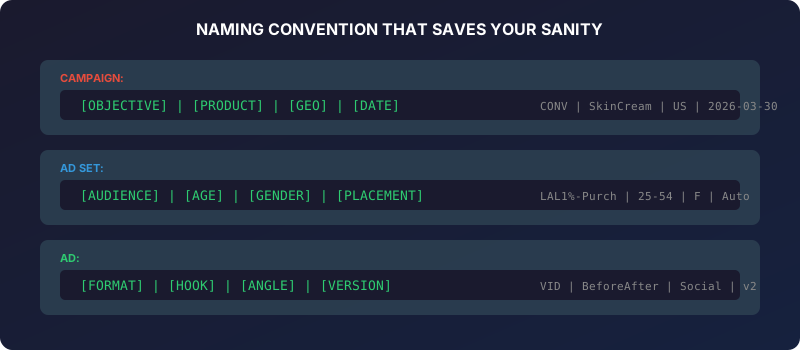
The format: [Level-specific info] | [Variable 1] | [Variable 2] | [Identifier]
Campaign: CONV | SkinCream | US | 2026-03-30
Ad Set: LAL1%-Purch | 25-54 | F | Auto
Ad: VID | BeforeAfter | Social | v2
Pipe separators scan faster than underscores or dashes. Include the date in the campaign name so you can track when each test started. Put the most important differentiator first: objective for campaigns, audience for ad sets, format for ads.
Budget Allocation Across the Structure
How you split budget matters as much as how you structure campaigns.
The 70/20/10 Split
- 70% to your scaling campaign (proven winners)
- 20% to your testing campaign (new audiences and creatives)
- 10% to retargeting (warm audiences)
This ratio shifts as you scale. Early on, testing might get 60% because you haven't found winners yet. Once you have 2-3 proven ad sets, flip the ratio so most budget goes to scaling.
CBO vs ABO Budget Control
With CBO, set minimum spend limits on ad sets you want to protect. Without minimums, Meta might route 90% of budget to one ad set and ignore the others. A $20 minimum on each ad set in a $100/day campaign ensures every audience gets tested.
With ABO, you control budget per ad set directly. This is better for testing because every audience gets equal spend regardless of early performance. The tradeoff: you have to manually reallocate budget based on results.
The Five Structural Mistakes That Drain Budgets
1. Too Many Ad Sets, Too Little Budget
Running 10 ad sets at $5/day each means none of them accumulate enough data. The learning phase requires roughly 50 conversions per ad set per week. At $5/day, most ad sets never get there. Consolidate into 3-4 ad sets with meaningful budgets.
2. Mixing Cold and Warm Audiences
Retargeting audiences (website visitors, past buyers) convert at 3-5x the rate of cold audiences. If you put them in the same campaign, CBO routes all budget to retargeting because it converts better. Your prospecting dies, and so does your pipeline.
3. Duplicating Instead of Scaling
Something works, so you duplicate it. Duplicated ad sets with the same audience compete against each other in the auction. Increase budget on the winning ad set by 20% every 3 days instead. Duplicate when you want to test a new audience, not to scale an existing one.
4. No Testing Isolation
If you change the audience, the creative, and the bid strategy all at once, you have no idea what drove the result. Test one variable at a time. Lock everything else. Read the data. Then test the next variable.
5. Ignoring the Learning Phase
Every ad set enters a "learning phase" when launched or significantly edited. During this phase, performance is volatile and costs are higher. Making changes before the ad set completes learning (roughly 50 conversions) resets the phase. Wait for the learning phase to finish before touching anything.
Need Stable Ad Accounts for Your Campaigns?
Get agency-level Facebook ad accounts with higher spend limits and fewer bans. Built for media buyers who need reliable infrastructure.
Get Started with AdCowFrequently Asked Questions
How many ad sets should I have per campaign?
For testing, 3-5 ad sets per campaign works well. Each ad set should test a distinct audience variable. Under $100/day budget, stick to 2-3 ad sets so Meta's algorithm gets enough data per ad set to optimize properly. At higher budgets, you can run 5-10 ad sets across multiple campaigns.
Should I use CBO or ABO for campaign structure?
Use CBO when you trust Meta to allocate budget across tested ad sets. Use ABO when testing new audiences and you want equal spend on each. Most media buyers run CBO for scaling and ABO for initial testing.
How many ads should I put in each ad set?
3-5 ads per ad set is the standard. Fewer than 3 gives the algorithm nothing to compare. More than 6 spreads impressions too thin, especially at lower budgets. Each ad should test one variable: different hook, different visual, or different format.
When should I split campaigns by objective?
Always. Never mix conversion and traffic objectives in the same campaign. Each objective trains Meta's algorithm differently. Run separate campaigns for prospecting and retargeting. This gives you clear data and prevents budget cannibalization.
How long should I run a test campaign before making changes?
Give each ad set at least 50 optimization events or 5-7 days, whichever comes first. Changing things before that means you are reacting to noise, not signal. The exception: if an ad set spends 2x your target CPA with zero conversions, kill it early.