Facebook Ads Metrics & KPIs: The Numbers That Matter in 2026
Ads Manager throws 50+ columns of data at you. Most of them are noise. A media buyer who watches the wrong numbers makes the wrong decisions: killing profitable ads, scaling losers, burning budget on metrics that look good but mean nothing for the business.
Below: the metrics that drive profit, the ones that mislead, and a diagnosis framework for turning raw numbers into clear next steps.
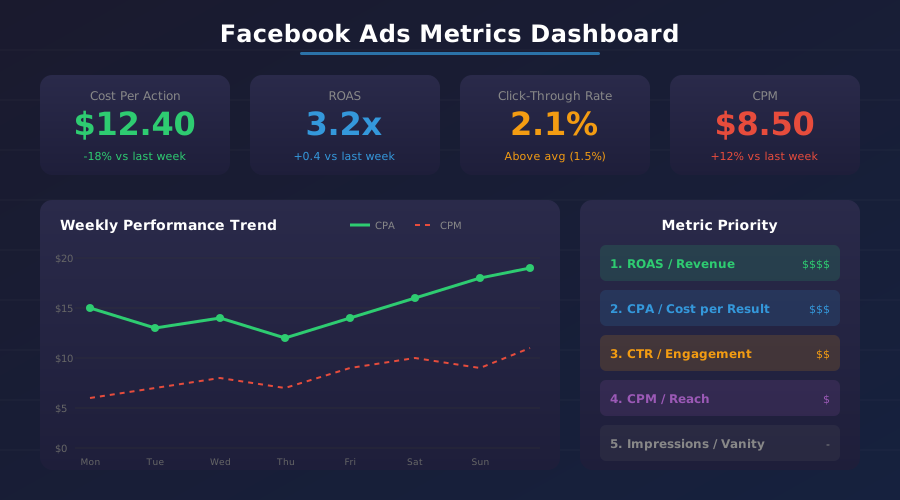
The Metric Hierarchy: What to Watch First
Not all metrics carry equal weight. Arrange them by proximity to revenue:
- ROAS / Revenue. Money in versus money out. If this number works, everything upstream is doing its job. Start here when reviewing performance.
- CPA (Cost per Action). What you pay for each conversion — a purchase, a lead, an install. CPA tells you whether you can afford to keep buying traffic at the current rate.
- CTR (Click-Through Rate). The percentage of people who see your ad and click. CTR measures whether your creative and targeting combination generates interest. A diagnostic tool, not a goal by itself.
- CPM (Cost per 1,000 Impressions). The price Facebook charges to show your ad. CPM reflects auction competition and ad quality. You cannot control it directly, but you can influence it through creative quality and audience selection.
- Impressions, Reach, Frequency. Volume metrics. They tell you how many people saw the ad and how often. Useful for detecting fatigue (frequency above 3) but not for judging performance.
Read them top to bottom. If ROAS is strong, a high CPM does not matter. If CPA is within target, a low CTR is fine because your landing page compensates. Work backwards from profit, not forwards from impressions.
Core Metrics Explained
ROAS — Return on Ad Spend
Formula: Revenue / Ad Spend. A ROAS of 3x means every dollar spent generates three dollars in revenue.
ROAS looks simple but hides a trap. It does not account for product cost, shipping, refunds, or payment processing fees. A 3x ROAS on a product with 30% margins means you break even. A 3x ROAS on a product with 70% margins means you doubled your money.
- Calculate your breakeven ROAS. Take your product price, subtract all costs except ad spend (COGS, shipping, fees). Divide the product price by the remaining profit. That number is your floor. Everything above it is profit.
- Track blended ROAS, not just last-click. Facebook attribution misses some conversions. Compare platform-reported ROAS with your actual bank account. The gap between the two is your attribution tax.
- ROAS benchmarks vary wildly by vertical. E-commerce averages 2-4x. SaaS lead gen might target 5-10x. Info products can hit 8-15x. Your breakeven ROAS is the only benchmark that matters.
CPA — Cost per Action
Formula: Total Spend / Number of Conversions. CPA tells you the acquisition cost for each result — a purchase, a signup, a lead form submission.
- Set a CPA target before launching. Work backwards from your customer lifetime value (LTV). If average LTV is $100 and you want 3x payback, your CPA target is $33.
- CPA fluctuates daily. Do not kill an ad because CPA spiked on Tuesday. Look at 3-7 day rolling averages. Single-day CPA is noise. Weekly CPA is signal.
- CPA by placement matters. Instagram Stories might deliver $8 CPA while Audience Network delivers $25. Break down CPA by placement to find where your money works hardest.
CTR — Click-Through Rate
Two versions exist in Ads Manager. CTR (All) counts every click — including likes, comments, and profile visits. CTR (Link Click) counts only clicks to your landing page. Track CTR (Link Click). The other one inflates numbers and tells you nothing about purchase intent.
- Below 1%: The creative does not resonate with the audience. Either the hook fails, the targeting is off, or the offer lacks pull. Swap the creative before adjusting audience.
- 1-2%: Average range for most verticals. Acceptable if CPA is on target.
- Above 2%: Strong creative-audience match. Scale this ad.
- Above 4%: Suspiciously high. Check for accidental clickbait or misaligned audiences that click but never convert.
CPM — Cost per Mille
What Facebook charges per 1,000 impressions. CPM depends on three factors you partially control:
- Audience competition. Targeting US males 25-34 interested in finance costs more than targeting females 45-54 interested in gardening. More advertisers bidding on the same audience means higher CPM.
- Ad quality ranking. Facebook scores your ad against competitors. Higher quality ads get cheaper delivery. Low engagement rates push CPM up because Facebook needs more impressions to find people willing to interact.
- Timing. CPMs spike in Q4 (holiday shopping season), during elections, and around major retail events. January CPMs drop 30-50% compared to December.
Average CPMs by region: US $10-18, Western Europe $8-14, Eastern Europe $3-7, Southeast Asia $1-4, LATAM $2-6.
Metrics by Funnel Stage

Different campaign objectives need different KPIs. Judging a brand awareness campaign by CPA is like grading a fish on tree climbing.
Top of Funnel: Awareness
Objective: reach new people cheaply. The audience has never heard of you.
- CPM: How efficiently you buy attention. Target under $12 in the US, under $5 in emerging markets.
- Hook Rate: Percentage of viewers who watch past 3 seconds of a video ad. Below 25% means the opening frame or first sentence fails. Above 35% means the hook works.
- ThruPlay Rate: Percentage who watch at least 15 seconds (or the full video if under 15s). Below 15% means the content loses people after the hook. Above 25% means the story holds.
- Reach and Frequency: Reach measures how many unique people saw the ad. Frequency measures how many times each person saw it. At the top of funnel, keep frequency below 2. Above that, you are paying to annoy people who already decided not to click.
Middle of Funnel: Consideration
Objective: get interested people to your site. The audience has some awareness.
- CTR (Link Click): Below 1.5% at this stage means the ad does not give enough reason to visit. Rework the offer or the creative angle.
- CPC (Cost per Click): What each click costs. Under $2 for most e-commerce. Under $5 for B2B and finance. Under $1 for entertainment and mobile apps.
- Landing Page View Rate: Percentage of link clicks that actually load the page. If 100 people click but only 60 page views register, 40% bounced before the page loaded. Speed kills conversions. Anything over 3 seconds loses people.
Bottom of Funnel: Conversion
Objective: turn visitors into buyers. The audience knows you and considered the offer.
- CPA: The metric that determines profit or loss at this stage. Compare CPA to your target daily.
- ROAS: Revenue generated per dollar spent. Only meaningful for e-commerce and direct response. Lead gen tracks CPA and cost per qualified lead instead.
- Conversion Rate: Percentage of landing page visitors who complete the desired action. Below 2% on a warm audience means the landing page has friction: unclear offer, too many form fields, slow load, weak CTA.
- Frequency: At bottom of funnel, frequency above 3 means you are showing the same ad to the same retargeting pool too often. Refresh the creative or expand the audience.
Diagnosis: When Numbers Go Wrong

Metrics do not exist in isolation. A spike in CPA traces back to a root cause. Follow this sequence:
High CPA, Low CTR
The ad fails to generate clicks. Not enough people move from impression to click, so each click costs more, and each conversion costs more.
Fix: replace the creative. Test a new hook. Try a different format. If static images are not working, test video. If video underperforms, test UGC. The creative is the cheapest and fastest lever to pull.
High CPA, Good CTR, Low Conversion Rate
People click the ad but do not convert on the landing page. The ad does its job. The page does not.
Fix: check message match between ad and landing page. If the ad promises a discount but the page shows full price, visitors leave. Simplify the page. Reduce form fields. Move the CTA above the fold. Add social proof where the visitor lands.
High CPA, Good CTR, Good CVR, High CPM
Everything works but Facebook charges too much for impressions. Auction competition eats the margin.
Fix: broaden the audience. Narrow targeting means fewer users and higher bids. Let Advantage+ expand the pool. Test a different geo. Shift budget to lower-CPM placements like Reels or Audience Network if they convert.
CPA Creeping Up Over Time
Performance degrades gradually. CPA was $10 two weeks ago, $14 last week, $18 this week.
Fix: check frequency. If frequency passed 3, the audience saw the ad too many times. Refresh the creative. If frequency is fine, check if the audience is saturated. A small custom audience runs out of new people. Expand or switch to a broader lookalike.
The Metrics That Mislead
Some numbers look important. They are not.
- Post engagement (likes, comments, shares). An ad with 500 likes and zero sales is a popularity contest, not a campaign. Engagement feels good. Revenue pays the bills.
- Video views. Facebook counts a view after 3 seconds. Someone scrolling past your video at normal speed triggers a view. The number inflates by design. Watch ThruPlay rate and hold rate instead.
- Estimated Ad Recall Lift. A modeled guess of how many people might remember your ad. It is a projection, not a measurement. Do not use it to judge performance.
- Relevance Score / Quality Ranking (alone). A high relevance score on an ad that does not convert is meaningless. These diagnostics matter only when combined with performance metrics. A low-relevance ad that prints money is better than a high-relevance ad that burns it.
- Impressions without context. 1 million impressions means nothing if nobody clicks. Impressions measure distribution, not effectiveness.
Building a Reporting Dashboard
Stop scrolling through Ads Manager columns. Build a view that shows only what matters.
Custom Columns Setup
- Open Ads Manager. Click "Columns" dropdown. Select "Customize Columns."
- Remove everything except: Results, Cost per Result (CPA), ROAS, CTR (Link Click), CPC, CPM, Amount Spent, Frequency, Landing Page Views.
- Save as "Performance Core." Use this view daily.
- Create a second view called "Diagnostics" with: Quality Ranking, Engagement Rate Ranking, Conversion Rate Ranking, Hook Rate (video), ThruPlay Rate, Landing Page View Rate.
Reporting Cadence
- Daily: Spend, CPA, ROAS. Spot disasters early. Do not optimize based on a single day.
- Every 3 days: CTR, CPC, Frequency. Look for trends. If CTR drops three days in a row, the creative is fatiguing.
- Weekly: Full analysis. Compare this week to last week. Identify winning ads, kill losers, plan next tests. Adjust budgets based on 7-day CPA, not daily fluctuations.
- Monthly: Blended ROAS across all campaigns. Cost per customer acquired. LTV-to-CAC ratio. Report to stakeholders using monthly numbers, not daily noise.
Your Metrics Mean Nothing If Your Account Gets Banned
Agency ad accounts for Meta, Google, and TikTok. Pre-approved spending limits up to $50,000/day. Stable delivery. No surprise restrictions. Commission from 1% on top-ups.
Get Agency Accounts at AdCow →Attribution: The Number You Cannot Trust
Facebook reports conversions using its own attribution model. By default, it counts conversions that happen within 7 days of a click or 1 day of a view. This creates two problems:
- Over-counting. Someone sees your ad, ignores it, Googles your brand name three days later, and buys. Facebook claims that sale. Google claims it too. Both platforms over-report.
- Under-counting. iOS privacy changes blocked many conversion signals. Facebook cannot track users who opted out of App Tracking Transparency. Your real ROAS is likely higher than what Ads Manager shows.
The fix: compare Facebook-reported revenue with actual revenue from your store or CRM. The ratio between the two is your attribution multiplier. If Facebook reports $8,000 in revenue and your store shows $10,000 from Facebook traffic (via UTM tracking), your multiplier is 1.25x. Apply it to future reports.
Benchmarks by Industry (2026)
Use these as reference points, not targets. Your breakeven numbers are the only targets that matter.
- E-commerce: CTR 1.5-2.5%, CPA $15-45, ROAS 2-5x, CPM $8-16
- SaaS / B2B: CTR 0.8-1.5%, CPA $30-120, CPM $15-30
- Lead Generation: CTR 1.5-3%, CPL $5-30, CPM $6-14
- Mobile Apps: CTR 1-2%, CPI $1-5, CPM $5-12
- Finance / Insurance: CTR 0.5-1.2%, CPA $50-200, CPM $20-45
- Education: CTR 1-2%, CPL $8-40, CPM $6-15
Q4 (October-December) inflates all cost metrics by 30-80% across every vertical. Plan budgets accordingly. January resets costs to the lowest point of the year — use it to test new offers and audiences.
Frequently Asked Questions
What is a good ROAS for Facebook Ads?
A good ROAS depends on your margins. For e-commerce with 60-70% margins, 2x ROAS can be profitable. For lower-margin products, you need 4x or higher. The number that matters is net profit after ad spend and cost of goods, not the ROAS figure alone.
What CTR should I aim for on Facebook Ads?
1.5% CTR is the baseline for link clicks. Above 2% means your creative and targeting are working well. Below 1% signals that either the audience does not care about the offer or the creative fails to grab attention. CTR matters only if it leads to conversions. High CTR with zero sales means clickbait.
How often should I check Facebook Ads metrics?
Check metrics once daily during active testing. Do not make changes based on a few hours of data. Facebook needs 50 conversion events per week to optimize properly. Wait for at least 1,000 impressions per ad before drawing conclusions about performance.
Why is my CPM so high on Facebook?
High CPM usually means one of three things: you are targeting a competitive audience that many advertisers bid on, your ad quality ranking is low and Facebook charges more to show it, or you are advertising during a peak period like Q4 holidays. Broaden your audience, improve creative quality scores, or adjust timing to bring CPM down.